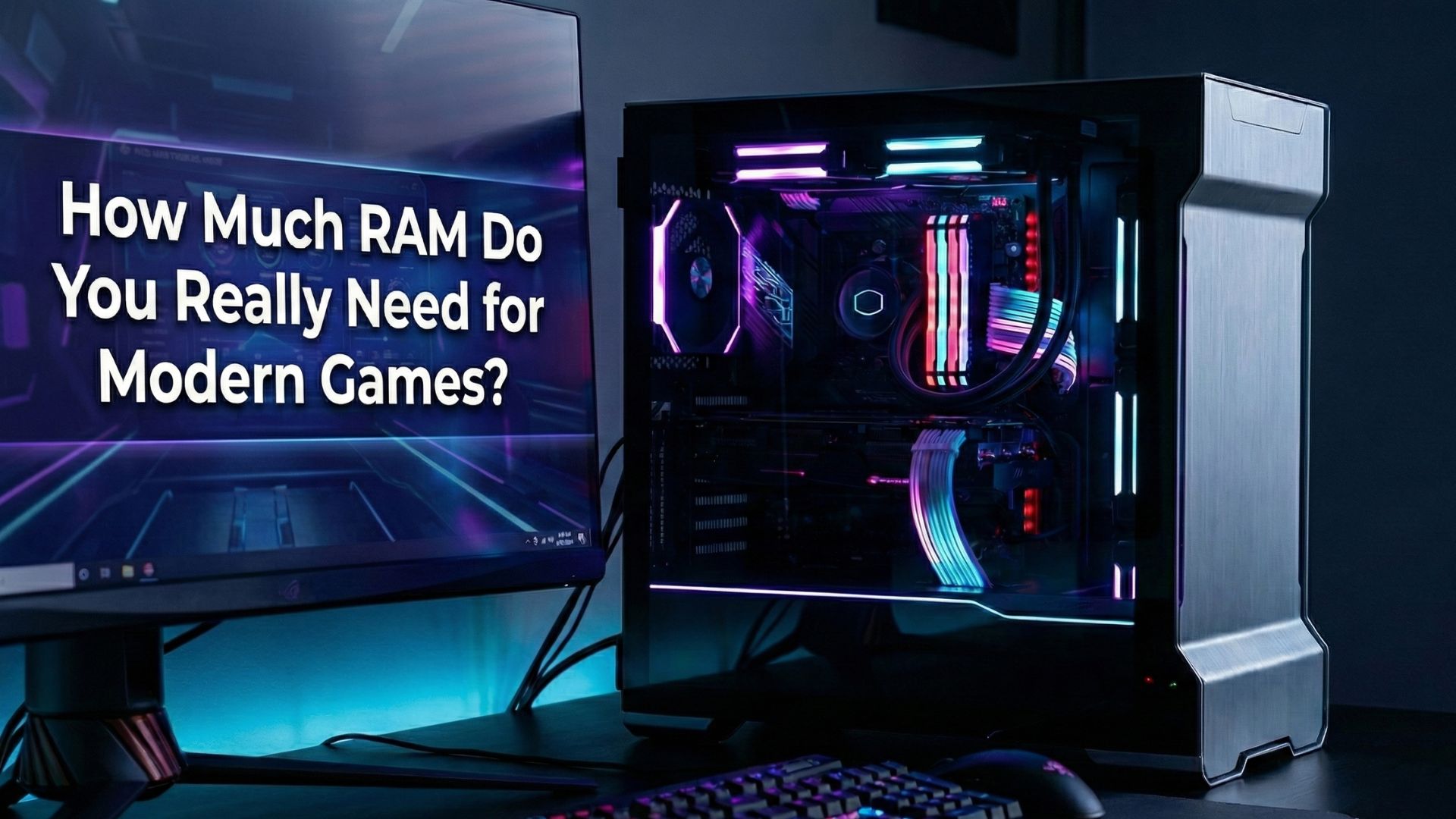
Choosing the right amount of RAM for gaming can feel confusing, especially because every year games become more demanding. While your GPU and CPU often get most of the spotlight, RAM plays a major role in how smoothly modern titles run. So, how much memory do you actually need today? Let’s break it down in simple terms.
Why RAM Still Matters in 2025
RAM acts as your PC’s short-term memory, storing active game data, textures, and background processes. If you don’t have enough of it, your system starts to slow down, stutter, or even crash. As modern games grow larger and more complex, RAM requirements naturally increase. Moreover, many players run Discord, Chrome, OBS, and game launchers simultaneously, which quickly adds extra pressure.
Is 8GB RAM Still Enough? (Not Really)
Only a few years ago, 8GB RAM was considered the minimum for gaming. However, that’s no longer the case. Although some lightweight esports titles like CS2, Valorant, or Fortnite can run on 8GB, you’ll face constant slowdowns.
Additionally, many AAA games simply refuse to launch with only 8GB. Even if they do, they will struggle with stutters and texture pop-ins. Therefore 8GB isn’t recommended for modern gaming, even on a budget.
Is 16GB the Sweet Spot? (Yes, for Most Gamers)
For most people, 16GB RAM is still the ideal balance of cost and performance. It allows you to run modern games smoothly, while also keeping background apps open.
With 16GB, you can:
- Play almost every game without issues
- Run Discord, browsers, and launchers without lag
- Get stable FPS in most titles
- Avoid common stutters
However, newer titles like Starfield, The Last of Us Part I already push very close to the 16GB limit. As a result, you may occasionally see performance dips, especially if you multitask heavily.
Do You Need 32GB RAM? (Increasingly Yes)
If you want a future-proof setup, then 32GB RAM is becoming the new recommended standard. More developers are optimizing their games for higher memory usage, and open-world titles with massive environments benefit noticeably from more RAM.
You should consider 32GB if:
- You play the latest AAA games at High or Ultra settings
- You stream or record gameplay
- You use Chrome with many tabs open
- You mod games heavily (Skyrim, GTA V, Cyberpunk)
- You want maximum smoothness with zero background bottlenecks
Furthermore, moving from 16GB to 32GB often reduces micro-stutters in RAM-hungry games. So, while not mandatory, 32GB offers a significantly smoother experience.
What About 64GB? (Only for Very Specific Needs)
Although 64GB sounds impressive, it’s completely unnecessary for the average gamer. You’ll only need this much RAM if you also do heavy professional work such as:
- 4K/8K video editing
- Game development
- Large 3D rendering projects
- Running multiple VMs
- Hosting servers
Gamers who only play even AAA titles won’t see any in-game performance benefit from 64GB.
How Much RAM Do Popular Games Use?
Here’s a quick look at the typical RAM requirements of modern games:
| Game Title | Recommended RAM |
|---|---|
| Cyberpunk 2077 | 16–32GB |
| Starfield | 16GB |
| The Last of Us Part I | 16GB |
| Red Dead Redemption 2 | 16GB |
| Apex Legends | 8–16GB |
| Hogwarts Legacy | 16GB |
| Microsoft Flight Simulator | 16–32GB |
As you can see, 16GB is usually enough, but more titles are benefiting from 32GB.
Single-Channel vs Dual-Channel RAM
Even if you choose the right amount, RAM configuration still matters. Dual-channel RAM (two sticks) offers faster performance than a single large stick. For example:
- 2 × 8GB = better performance than 1 × 16GB
- 2 × 16GB = better than 1 × 32GB
This is because dual-channel doubles your memory bandwidth, giving your CPU faster access to data.
DDR4 vs DDR5: Does It Matter?
If you’re building a new PC, DDR5 is the future. It offers higher speeds, lower power use, and better performance in modern engines. However, DDR4 is still widely supported and works perfectly fine for gaming.
In most cases, RAM capacity matters more than RAM generation.
Final Recommendation
To simplify everything:
- 8GB: Not enough anymore
- 16GB: Good for most gamers
- 32GB: Best for AAA, streaming, future-proof builds
- 64GB+: Only for professional workloads
Although 16GB still handles most modern games well, shifting to 32GB ensures smoother gameplay especially as titles keep growing in size and complexity.